Christmas Eve
Never Kiss a Man in a Christmas JumperChristmas Eve is the novel’s recurring threshold between expected family and romantic life and the life its characters actually enter. Across three wedding stories, the date shifts from the setting of a failed beginning to a moment of hope under pressure and, at last, the occasion of Maggie O’Donnell and Marco Cavelli’s marriage. Around it, changing holiday plans expose Maggie’s fear of being left alone even as the people she loves begin to build lives of their own.
Earlier Weddings and Unexpected Beginnings
Three years before the present story, Leah was meant to marry on Christmas Eve. That plan ended when she discovered her fiancé with one of the bridesmaids and drove away in distress, still wearing her wedding dress. A vehicle breakdown left her stranded in a snowstorm outside Rob’s cottage in Scotland, where she met the man who would become her husband. The planned ceremony therefore marks not simply a wedding that did not happen, but the start of an unforeseen relationship. By the time Maggie hears the story, Leah and Rob are happily married and expecting another child; the date’s history has become one of upheaval that opens onto a different future.
The contrast matters to Maggie because her work brings her close to other people’s weddings while her own life has not included marriage or the experience of being in love. She sees the contentment Leah and Rob share, and recognizes how distant that world has seemed from her own. Christmas Eve consequently carries an emotional charge beyond its place on the calendar: it gathers memories of romantic hopes, disappointments, and the possibility that a life can take an unexpected course.
Holiday Plans and the Prospect of Being Alone
In the present story, Christmas arrangements unsettle Maggie before the day arrives. Her daughter, Ellen, explains that she has been invited to Paris with Jacob and his family. Maggie’s first reaction is to resist the prospect of Ellen’s first Christmas away from home, but she understands that Ellen is nearly nineteen, independent, and entitled to make the trip. The conversation exposes the changing balance between mother and daughter: Maggie has raised Ellen to be capable of leaving, yet finds herself unprepared for what that independence means to her own place in the family.
Paddy also considers spending the holiday elsewhere, accepting a last-minute cruise to the Canaries with his friend Jim. Maggie tries to respond warmly, but experiences his departure as another person abandoning what she thinks of as her Christmas plans. With Ellen expecting to travel and Paddy preparing to leave, the prospect of Christmas alone becomes harder to dismiss. Their choices reflect ordinary changes in family life, but to Maggie they concentrate the fear that the familiar household and its holiday customs are slipping away.
Maggie conceals that fear by telling Ellen and Paddy, separately, that she will spend Christmas with the other. When Ellen and Paddy discover the contradiction, Ellen confronts her mother: neither of them wants Maggie to be alone. The lie has been an attempt to spare them guilt, but its discovery makes clear that Maggie’s loneliness is visible to the people she hoped to reassure. The episode turns Christmas from a set of competing travel plans into a test of whether family members can speak honestly about their needs while allowing one another to change.
Marco’s place in Maggie’s holiday calculations deepens the conflict. She has grown close to him while helping care for him during his recovery, and being with him makes her feel happier and more at peace. Yet she expects him to leave for Scotland and then Chicago, so time together at Christmas seems likely to make parting harder. She tells her family that she will go to Scotland with him, although she plans to stay home. Part of her reason is that she wants to attend the Christmas Eve wedding of Isabel and Michael; another is her reluctance to turn a temporary relationship into a goodbye made more painful by the holiday. Christmas Eve thus stands at the intersection of duty, attachment, and anticipated separation.
A Wedding Changed by Illness
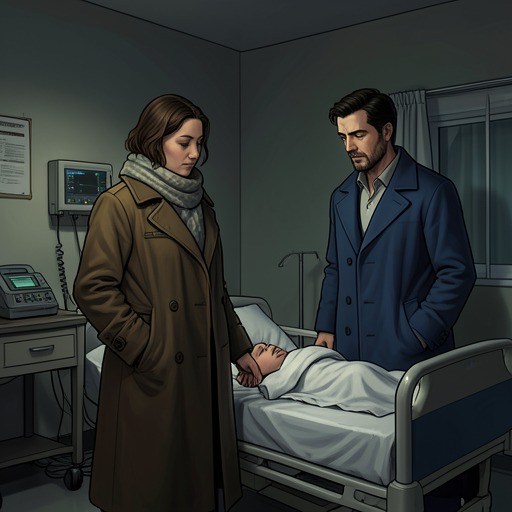
Isabel and Michael’s wedding is planned for Christmas Eve, but Michael collapses at home and is taken to hospital for tests. The news that he is seriously ill makes the planned ceremony seem uncertain and distant. Rather than wait for the wedding they had imagined, Isabel and Michael ask to marry in the hospital, and the staff help make that possible. The celebration’s form changes because time and health can no longer be taken for granted; the commitment at its center does not.
Maggie arrives with the wedding dress she has made after a year of fittings and conversations with the couple. Instead of a village church, the wedding takes shape in the hospital: a small room, a bedside groom, and staff and patients gathering along the corridor. Flowers donated by patients brighten Michael’s room; a nurse uses Marco’s laptop to provide the bridal entrance music. Isabel walks through the applauding crowd with her father, while Maggie and the bridesmaids complete preparations in the nurses’ break room. These practical contributions turn a medical setting into a shared ceremony without concealing the serious circumstances that brought the couple there.
Isabel asks Maggie and Marco to stay, insisting on hope and treating the ceremony as the beginning of married life. Michael, weak and connected to a drip, reaches for her as she enters. The wedding is not the celebration the couple had planned, but it contains what they value most: love, commitment, and the certainty that they are choosing one another. The improvised gathering—confetti, champagne, cheers, and even patients joining the celebration—makes Christmas Eve a time when a threatened future is met with a deliberate act of hope.
A New Beginning for Maggie
One year later, Christmas Eve is the date of Maggie’s own wedding to Marco. The epilogue shows her exhausted after attending many weddings, now experiencing the demands of being at the center of one herself. She has designed her dress for her marriage, and sees herself in its fairy-tale setting as an unlikely bride. Her father gives her away, and Ellen carries out her maid-of-honour duties. The familiar wedding roles have become personal: Maggie is no longer only the dressmaker standing beside other brides.
The marriage follows Marco’s assurance that their future need not depend on having children. He tells Maggie that he wants a real life with her, suggests adoption or sharing time with Luca and Rob’s child, and asks her to begin that future with him at their first Christmas together. Maggie accepts. The following Christmas Eve confirms that the proposal has become a marriage, giving the date a new place in her story: not the promise of a perfect life, but the occasion on which she enters a future with Marco.
Across Leah’s abandoned wedding plans, Isabel and Michael’s hospital ceremony, and Maggie’s marriage, Christmas Eve repeatedly changes the meaning of a beginning. It gathers romance and family ritual, but refuses to make either effortless: plans are disrupted, illness alters a celebration, and the possibility of separation shadows intimacy. Its final turn is toward commitment. For Maggie, the date comes to signify not the preservation of the old family arrangement, but the creation of a new one.